Stuff that occurs to me

All of my 'how to' posts are tagged here. The most popular posts are about blocking and private accounts on Twitter, also the science communication jobs list. None of the science or medical information I might post to this blog should be taken as medical advice (I'm not medically trained).

Think of this blog as a sort of nursery for my half-baked ideas hence 'stuff that occurs to me'.

Contact: @JoBrodie Email: jo DOT brodie AT gmail DOT com

Science in London: The 2018/19 scientific society talks in London blog post

Showing posts with label Nightingale Collaboration. Show all posts

Sunday, 23 July 2017

Homeopathy 'banned on the NHS' - nearly, but not quite

NHS England is updating its guidance to Clinical Commissioning Groups (CCGs), recommending that certain items offered in primary care should no longer be prescribed. This includes homeopathy but some herbal remedies are in there too, also glucosamine + chondroitin used (ineffectively as it turns out) for osteoarthritis pain.

The document outlining the recommended changes was published on 21 July 2017 and is called Items which should not routinely be prescribed in primary care: A Consultation on guidance for CCGs. It's out for public consultation until 21 October 2017 (see pg 7 of 48 of the linked docuent on how to respond).

A. Things I want to consider in this post, the short version
1. Has homeopathy been banned from the NHS? 
No, not yet

2. Is it likely that homeopathy will be removed from the NHS?  
Seems pretty likely

3. Homeopathy costs a fraction of the total NHS costs, why do skeptics want it removed?
The evidence isn't good, also to minimise any unwarranted positive associations with healthcare

4. Are there any reasons to keep homeopathy on the NHS? 
Slightly dishonest ones

5. What's been the role of skeptics in removing homeopathy from the NHS? 
Probably helped

B. Things I want to consider in this post, the longer version
1. Has homeopathy been banned from the NHS?
Not yet. The document acknowledges that the evidence for homeopathy is poor and that homeopathy should not be prescribed, however this is a consultation document not an edict. Also this will affect England, not the whole UK.

2. Is it likely that homeopathy will be removed from the NHS?
I think so - it's widely acknowledged that it's a waste of money and there is little support for it being on the NHS. To be fair homeopathy has been declining on the NHS for two decades as this bar chart from the Nightingale Collaboration. This is more tidying up loose ends than a big new thing.


3. Homeopathy costs a fraction of the total NHS costs, why do skeptics want it removed?
While it's true that the homeopathy spend is now under £100,000 (a drop in the ocean compared with total NHS costs) it's not just about costs. We don't want money wasted on unevidenced treatments (this includes pharma drugs too), even if it is only a small amount of money. But there's also the 'halo effect': homeopathy benefits by its association with healthcare, the NHS is effectively giving its backing to nonsense. Removing it from the NHS removes this positive association. Annoyingly homeopathy also benefits from the fact that you can buy it in many highstreet pharmacists but that's a different argument.


4. Are there any reasons to keep homeopathy on the NHS?
Not good ones, no. Some doctors have argued that patients who are distressed about perceived ill-health, despite not actually being unwell, might benefit from homeopathy or placebo pills.

"TEETH" stands for "Tried Everything Else, Try Homeopathy".


The idea would involve doctors knowingly (or perhaps even unwittingly) giving patients inert medication with the aim of making them feel better (placebo effects, being taken seriously etc) without causing any side-effects. Another possible benefit is keeping a link with a patient who might otherwise withdraw from appropriate healthcare and explore unhelpful and costly options from quacks.

To be honest I do have some sympathy with this notion. The dishonesty troubles me - it's basically lying to a patient 'for their own good' but I can see examples of where I might go along with this (which also troubles me!).

Here a GP writes about 'heartsink' patients (where your heart sinks as what's ailing them isn't clear, nor is the solution) in an article on the Faculty of Homeopaths website. The FoH is a society of medical doctors who are also homeopaths.

"Another group of patients for which homeopathy can be helpful is those who frequently appear in GPs’ surgeries presenting with a whole host of “functional disorders”. Despite undergoing the full gamut of blood and hospital tests, no abnormality in the body is found. Nevertheless, these “heart sink” patients are clearly suffering from pain and discomfort, which is blighting their lives. This is understandably frustrating for them, for they know full well something is awry but there is no medical evidence for this.

Sometimes conventional medicines can be useful, but once again they are symptomatic treatments which may also produce unpleasant side-effects, resulting in the patient feeling even worse. Homeopathy affords me another approach in trying to help these patients. It doesn’t work for them all, but I’m frequently surprised at how many it does help."
Source: https://facultyofhomeopathy.org/homeopathy-general-practice-2/

5. What's been the role of skeptics in removing homeopathy from the NHS?
The term 'Skeptics' is generally assumed to mean activist bloggers but obviously includes people who aren't bloggers but who are also skeptical of homeopathy - including scientists, doctors and other healthcare professionals, teachers, people who've tried it but experienced no real benefit from homeopathy, members of the public, anyone.

It's difficult to prove causality. My perception is that online skeptical activism, particularly targeted at homeopathy, really got going in the early-mid 2000s, coalescing around Ben Goldacre's Bad Science colummn and blog. Obviously scientists and doctors have obviously been skeptical of homeopathy pretty much since it was invented. Prof David Colquhoun has been blogging about homeopathy since the very early 2000s and published (in a journal) a re-analysis of some homeopathy data in a paper in 1990 - I'm sure others have too, it's just we happened to have a conversation about this recently!

The focus of skeptic activism can be both narrow and targeted (for example getting something changed, eg getting an advert taken down, getting an event moved from an academic setting etc) or wider (eg contributing to people's awareness of what homeopathy actually is) and I think both feed into each other. I think of the former as 'meat' and the latter as 'marinade' and I think skeptic activism has done both very well. It seems as if articles in the press about homeopathy are much more critical and less credulous than they have been in the past - I don't know if this can be attributed to skeptics but I know that quite a few of us have contacted journalists to point to better information.

In late 2009 the UK Government announced that it was seeking examples of topics in which a science Select Committee could "assess the Government’s use of evidence in policy-making", inviting the public to suggest topics. Homeopathy was one of many, and was chosen to be the second 'evidence check' resulting in a 2010 document recommending that funding be withdrawn.

The fact that homeopathy's been included in the current consultation is also largely due to the efforts of the Good Thinking Society which has mounted legal challenges to Clinical Commissioning Groups to get them to stop funding homeopathy, as well as trying to get it blacklisted from NHS spending.

Further reading
Skeptic successes in homeopathy (originally published 24 August 2015 but regularly updated)


Tuesday, 4 April 2017

Homeopathy is hardly exactly escaping the NHS 'ban'

It's Homeopathy Awareness Week next week or as we in the snark community have it 'Homeopathy Bewareness Week'. Don't get taken in by their lies ;-)

Actually homeopathy's already been having a pretty interesting week this week.

First, plenty of people noticed its absence in the list of things the NHS is considering not paying for anymore. Second, considerably fewer people noticed that the NHS has kinda already considered this, by paying less and less for it each year anyway.


There are two sums of money at issue
  • the amount spent on NHS England prescriptions for homeopathy - less than £100,000 (see blue graph below) for 6,821 prescription items (red graph below) in 2016
  • the amount spent on the wider infrastructure for homeopathy (staff, buildings etc) - apparently about £4m to £5m in 2016

In the mid-1990s the NHS in England spent upwards of £800,000 on homeopathy for 170,000 prescription items. This has dropped precipitously over the years, as you can see from the informative and entertaining graphs below.

Picture credit: Nightingale Collaboration, used with permish :)
Version for homeopathy fans
Well done! You began the year on 1 Jan 2016 with not a single homeopathy item prescribed but ended the year with a whopping increase to 6,281 items prescribed - an increase on a par with infinity.

Where was I...
I don't have the breakdown for the non-prescription costs, estimated to be several million at the moment. It's great that the prescription costs are dropping but we may still be wasting millions on this non-treatment on the NHS.


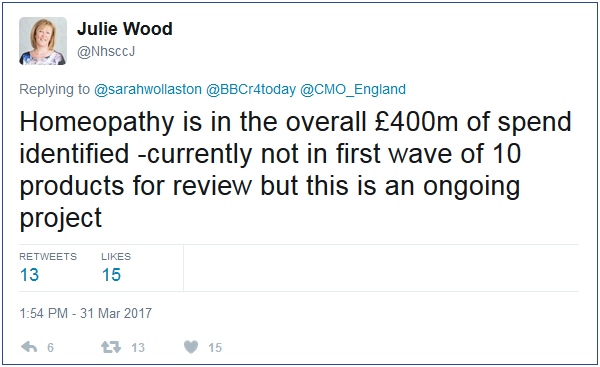
Although homeopathy wasn't mentioned in the first raft of 'things to consider banning' it will indeed be included in later considerations, according to Julie Wood's tweet below (she's the Chief Executive of NHS Clinical Commissioners).

https://twitter.com/NhsccJ/status/847794271512080386
"Homeopathy is in the overall £400m of spend identified - currently not in
first wave of 10 products for review but this is an ongoing project"

In other words, skeptics are pushing at an open door. We're not really trailblazing the decline of homeopathy on the NHS, it's happening anyway. Perhaps we've contributed to the changing mood though - for example newspaper reports now seem less likely to champion it and more likely to laugh at its improbability.

Unsurprisingly the magazine 'What Doctors Don't Tell You' (they don't like me much) have regurgitated the misinformation ("Homeopathy escapes the NHS cuts") and also managed to add in another error at the end ("The Swiss health authority has announced that homeopathy is effective enough to be included among therapies that can be claimed under health insurance plans..."). The Swiss have done no such thing and explicitly acknowledged that homeopathy was unable to provide evidence of efficacy. However, bafflingly, they are continuing to reimburse its use in health insurance but only if administered by a doctor, so there's that I suppose.


Background reading on NHS prescription costs
Every year the costs of prescriptions in England are published. Skeptics, being amused by the drop of homeopathy spending on the NHS have kept an eye on the cost for each year, going back to 1995 (info is publicly available).

Prescription Cost Analysis, England - 2016 [NS]
Publication date: March 30, 2017
Prescription Cost Analysis, England - 2016: Data Tables [.zip]
The [NS] means a publication that is within the scope of National Statistics, the lack of a [PAS] next to it means that no Press Announcement is Scheduled.
NHS Digital Publications calendar April 2016 - March 2017
NHS Digital Publications calendar (future)
 
Background reading on Swiss health authority and homeopathy
The Swiss rejected homeopathy as a 'treatment' that could be reimbursed in 2005 however lots of Swiss people voted for it in 2009 to be included, among some other ineffective treatments. The health authority requested evidence of effectiveness but eventually admitted defeat and surprised everyone in 2016 with this announcement:
"In a statement released on Tuesday, the interior ministry said it had come to the conclusion that it was “impossible to provide such proof for these disciplines in their entirety”.

They will thus be treated on a par with other medical disciplines, when it comes to health insurance.

The ministry plans to continue allowing reimbursements of treatment costs by compulsory health insurance, provided they are administered by certified medical doctors." 

Bad news for homeopathy fans though, it will continue to be scrutinised...


Sunday, 9 March 2014

Homeopaths often surprise me, sometimes the ASA do too

On Wednesday 26 Feb 2014 the Advertising Standards Authority (ASA) published an adjudication against a homeopathy website which had been making misleading claims.

-- Edit 13 March 2014
Just spotted that on 11 March the homeopathy website (Islington Homeopathy) was added to the list of non-compliant online advertisers. Possibly the ASA will also take out a promoted advert that appears on search engine results whenever someone searches for the company.  --

The claim made was that homeopathy has been part of the NHS since it began (true), but it was written in such a way that implied the NHS endorses homeopathy (manifestly not true as it has begun the gradual process of removing funding and presumably dismantling infrastructure with hospital closures) as shown in this pic below, used with permission from Alan Henness of the Nightingale Collaboration.


Someone complained (wasn't me, I didn't spot that one) and the ASA took action and investigated.

Around the time the investigation was happening, the patients of one of the people working at the homeopathy organisation wrote a letter to the local newspaper almost-but-not-quite blaming the Nightingale Collaboration, who then wrote back to point out that they'd had nothing to do with the complaint.

Excerpt from original letter
"AS patients of a clinic in Islington where we see our homeopath, Jennifer Hautman, RSHom, we are surprised to learn that the Advertising Standards Authority (ASA) is pursuing a single complaint regarding 24 words on the clinic website that state homeopathy “is sanctioned by the UK government and has been an integral part of the National Health Service (NHS) since 1948”.

This is a statement of fact. Homeopathy has been part of the NHS since it was founded in 1948."
Source: Islington Tribune, Letters to the editor 'Homeopathy has always had NHS role' 15 November 2013

The letter goes on to imply, somewhat evasively, that the Nightingale Collaboration could be just the sort of organisation to be behind such a complaint.  

There's a response letter from Alan Henness of the Nightingale Collaboration (disclaimer - he's a friend of mine, he doesn't pay me, I don't pay him, I'm not a member of the NC as they don't have a membership structure) pointing out that they'd had nothing to do with this particular complaint.
"I can assure the writers of this letter and Hautman that the Nightingale Collaboration is not the complainant in this case and it has nothing to do with us. We were not aware of this complaint until we read this letter."
Source: Islington Tribune, Letters to the editor 'Legal, decent, honest and truthful?' 28 November 2013

A follow-up letter comment to the Islington Tribune from Alan, after the adjudication was published, highlights that the complaint was entirely about the way in which the claim was phrased. I think I spotted a bit of mild snark there too - when you put in a complaint to the ASA I understand that they do tell the organisation what the complaint's actually about. For the patients to have heard about the complaint but not seem to know the full story suggests that someone didn't really understand what was going on or just didn't bother to mention it.

The page under investigation - http://www.homeopathyislington.co.uk/ - still implies that the NHS sanctions homeopathy (I'd not be surprised if they're added to the non-compliant online advertisers at some point - edit 13 March: this has now happened - and have an ASA advert appearing whenever anyone searches Google for them) but surely the list of conditions on the page is much, much worse...?!

I don't really think the phrase "Patients seeking to use homeopathy often come with these conditions:" is a permitted way of getting round the fact that you can't claim that "homeopathy can help with the following conditions" which is partly why I'm so surprised the ASA didn't look into that.

The Committee of Advertising Practice (CAP) is pretty clear that people who aren't medically qualified should "not refer to serious medical conditions".


It seems that one of the clinic's homeopaths also has her own website - http://www.hautmanhomeopathy.com/ - and perhaps not surprisingly this page also has a shopping list of conditions: http://www.hautmanhomeopathy.com/home/who-can-benefit-1


My favourite bit on that page is the 'full list of medical conditions where positive findings for homeopathy have been reported'. That page links to http://www.britishhomeopathic.org/evidence/Conditions_where_positive_evidence.html which, delightfully (I can hardly keep the sniggers down) returns a 404 'page not found' error. Forgive my childish amusement.

Arf!


The correct link would actually be this one http://www.britishhomeopathic.org/conditions-with-overall-positive-evidence-for-homeopathy/

As always, I'm afraid I no longer take comments from anyone in support of homeopathy.