Stuff that occurs to me

All of my 'how to' posts are tagged here. The most popular posts are about blocking and private accounts on Twitter, also the science communication jobs list. None of the science or medical information I might post to this blog should be taken as medical advice (I'm not medically trained).

Think of this blog as a sort of nursery for my half-baked ideas hence 'stuff that occurs to me'.

Contact: @JoBrodie Email: jo DOT brodie AT gmail DOT com

Science in London: The 2018/19 scientific society talks in London blog post

Thursday, 16 August 2012

Because you haven’t opened an email in more than a year, your e-mail alerts have been cancelled

This isn't a post being snarky about Nature.com - it's just that they happened to send me this in December last year and it made me giggle and then wonder about people knowing what emails I have or haven't opened. I was reminded of it today and thought I'd dig it out.


I've done a bit of a series of blogposts recently ('fun with paranoia') on some of the various ways in which your data is shared, or links that you share may carry extra information about you. My favourite example is the one in which I searched for volunteering options local to me by putting in my postcode. The address for any page I looked at after that 'inherited' my postcode and I only noticed when I copied the link of an opportunity to share on Twitter.

When you click on a link in an e-lert type of email the webpage collects some information - it probably could work out who you are although I don't think anyone's particularly interested in that. I suspect the body of data is more useful for telling you how many people clicked on something.

Normally I'd never share this great long link (emphasis added)
http://www.bfi.org.uk/news/bfi-statistical-yearbook-reports-stand-out-year-uk-film-2011?utm_medium=email&utm_campaign=20120816-bfi-news&utm_content=20120816-bfi-news+CID_3 [[alphanumeric gibberish redacted]] &utm_source=cm&utm_term=Read+more

This came from an e-lert from the BFI and is a rather fascinating page on the stats of film in the UK and the changing face of how we view films in Britain etc (also there is such a thing as the "BFI’s Research and Statistics Unit", I had no idea). Everything after '2011' in the long link text above is data about how I (although I can't tell if it's specifically 'I' or just generic to 'all who receive this email') reached the page. E-lerts report back to their owners the percentage of email recipients clicking on different sections. There's nothing particularly sinister in any of this, I just find it all quite interesting.

The link I'd share would be the pruned version http://www.bfi.org.uk/news/bfi-statistical-yearbook-reports-stand-out-year-uk-film-2011, much tidier.

Back to Nature though - it's true I didn't open their emails but I'm not certain that unsubscribing me is the best strategy (assuming it's not just a random spam email of course, it looks legit). Perhaps I check my emails on the way to work, clock that Nature have sent me something and then visit their page when I get to my work computer without using any of the links in the email... perhaps now that I no longer receive these notifications I no longer think to do this ;)


Monday, 6 August 2012

Traverse City Film Festival - tweets about Whole Lotta Sole

Assuming the 'embed function' from this Storify collection works (might have to wait for the page to load) there should be a panel below containing a bit of back history about the film Whole Lotta Sole and a bunch of tweets from people who saw it recently at the Traverse City Film Festival. Which reminds me I really must get a shift on and finish off my posts on #wholelottasoleapalooza (see June 2012 in the archives).


Saturday, 4 August 2012

Rendering letters with umlauts etc - possibly more than you wanted to know about Latvian orthography

The edit log 

14 October 2019 - I've finally found out what this phenomenon is called - Mojibake. Plent of detail in that Wikipedia page, scroll down for English and other Western European languages to see what we're up against. If I've understood correctly it arises when text encoded in the UTF-8 character set is misinterpreted as characters from the ISO-8859-1 set. I've also added the ö after discovering "Björk"

5 November 2015 - Tom Morris has created an online tool that lets you type in gibberish, like Ropažu  and it will return the correct form, ie Ropažu

15 November 2014 - now with added – - which codes for a hyphen.

13 September 2012 - new bit on Morse code


The actual post
Part of my job at the moment involves transferring the names and addresses of people who want to subscribe to our schools magazines (cs4fn, ee4fn and Audio4fn) onto an Excel spreadsheet / database. Generally this is a bit of cutting and pasting, making sure things are appropriately formatted and filling in gaps. There are plenty of addresses from India and the US and I'm learning quite a bit about cities and states in those countries, and of course zip codes.

There's recently been a crop of addresses coming in from Latvia and Hungary and I've been surprised that some of the words have been completely unreadable. I know that those languages have extra letters with diacritical marks on them (ümlåuts and things of that îlk) but those letters should show up fine on screens and 'come through' OK from the online form. What comes through is completely unreadable, but it seems to have a consistent format.

Each mystery letter is rendered by a capital letter A with a diacritic (eg Ä) and then another character (
«) forming the combination Ä« (which turns out to be ī as in Līgatnes and not LÄ«gatnes). 

At first I thought they'd just be vowels and that someone whose city name might be say London might not mind desperately if I rendered it as Londan. Then I realised, after looking at Latvian orthography on Wikipedia and the letters of the Hungarian alphabet, that c, s, n, k and other letters are involved. You can get some wiggle room on vowels but less so on consonants - and the length of the word and percentage of correct letters will have an impact too.

Because of the consistency I assumed that there'd be a standard gloss available that told you which letters to replace the mystery characters with, after all I can't be the first person to be faced with BÄ“rziņš and not know immediately what to do with it (it turned out to be Bērziņš). [Edit, found this gloss-like thing which may be useful: UTF-8 character debug tool]


It's really quite difficult to search just for the Ä“ character by itself, Google hasn't the faintest idea what to do with it. For some of the longer names the word did come up in Google - quite amusingly - and in some cases the Latvian version was also available from which I could work out what the letters meant.

I was also surprised that 'place names in Latvia' brought up this detailed resource which has helped me home in on likely suspects. In most cases I've had to 'triangulate' (I love that word) information from more than one source. Thanks too to @helga_j who was able to work out a word I was particularly struggling with, which opened up other words for me (once you've got another letter it's easier to search the place names database).

I am really quite amazed though that there isn't already a resource where you can type in your mystery characters and it tells you the correct letter. So I've decided to start one, in the sense that you can read off the list below and find your mystery letter. There will be a few more to add as I continue to do this, I've not solved all of them yet. 


This is probably the closest I'll ever get to working on cryptography type things at Bletchley Park. I really wasn't expecting to enjoy this as much as I have done but I hope others find it useful if they ever search for mystery names.

I'm assuming that these characters are consistent across all languages and that all computers would render Ä“ as ē - could be wrong.


Probable 'translations' of characters into letters
Copy and paste into notepad / plain text, or re-size


Mystery letter
Likeliest real letter
Ä
ā
ļ
ļ
Ä“ / Ä—
ē
Ä«
ī
Ä·
ķ
Å¡
š
ņ
ņ
Å«
ū
ž
ž
Å„
ń
Ã
í
á
á
ó
ó
ö
ö
ê
ê
é
é


Ä
Ä might be ā


ļ = ļ
ZÄ«
ļu = Zīļu


Ä“ / Ä— = ē
JÄ“kabpils = Jēkabpils
BÄ“rziņš = Bērziņš

Ä« = ī
KuldÄ«ga = Kuldīga
LÄ«gatnes = Līgatnes

Ä· = ķ
BiÄ·ernieku = Biķernieki or Bikernieki

Å
Å¡ = š
Bērziņš
= Bērziņš

ņ = ņ
BÄ“rziņš = Bērziņš


Å« = ū
mÅ«zikas (in context = music), so I searched what the Latvian word was for music = mūzika
LÅ«kina = Lūkina

ž = ž
Ropažu = Ropažu, in English = Ropaži

Å„ = ń
Powstańc
ów = Powstańców


Ã
í = í
Nyíregyháza = Nyíregyháza

á = á
Nyíregyháza = Nyíregyháza


ó = ó
József = József 


ö = ö
Björk =
Björk


ê = ê

Ciências = Ciências


é = é
route de l'aéroport = route de l'aéroport


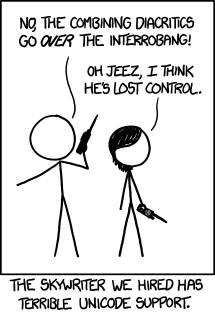
http://imgs.xkcd.com/comics/encoding.png
Encoding


Morse code

Edit: 13 September 2012
I have discovered, after visiting the Orkney Wireless Museum that people bothered to include accented letters in Morse code exchanges, or at least made it possible to use some of them - I just took a snap of this and didn't investigate any more to find out how commonly they were used. I'd have assumed that diacritical marks would have been the first casualty of war* but perhaps people set much greater store by them than I do (speaking as someone who has no accented letters in my name and assumes you can kind of survive without them). I am rather delighted that they are included though :)

*Obviously Morse code was used as a communication tool under many circumstances, not just war.
 
Morse code key (as in explanation)
Orkney Wireless Museum, taken in September 2012


–
Edit: 15 November 2014
While looking at some text about a road accident in 1863 I spotted a lot of – characters in it which are obviously meant to be some punctuation mark, but which? 


"on the evening of 26th December I was at Mr. John's, Mile-end-road, and saw the prisoner—he was racing; he was in a cart and horse—there was another cart alongside of him—this was in the Mile-end-road; Globe-road crosses the Mile-end-road—I saw an old gentleman knocked down in Globe-road by the horse the prisoner was driving—there is a crossing there across the road—there were not many persons about—the two horses and carts were racing together; one was trying to get before the other—it was pretty light; it was about 5 o'clock, between 5 and 6."

Delightfully, googling for the characters actually brought up quite a lot of stuff, including this gloss which I've adapted from Mark McBride's blog post.

… = ...
– = –
’= ’
“ = “

Edit: 18 November 2014
I've just had another example of this, with "Connah's Quay" which rendered on-screen as "Connah’s Quay".


Fun with paranoia: ways in which data give you away - a collection


This morning I read Tom Morris' post on a new (to me) feature in Quora which shares with other users which questions you've been reading. Being a social tool there's an argument to be made that Quora's behaving quite normally in doing this. Some people have apparently been in uproar about this and have quit Quora - which as Tom points out is a bit of an overreaction given that you can just switch off this setting. I checked to see what setting I had on mine and found it was already off (presumably by default as I'd not known anything about it until I saw Tom's post).

But Tom's clear point is that without knowing about this setting someone could actually be giving away information about themselves that they might not want to. He gives some good examples of situations where that really might not be what someone would want.

4 August 2012

I retweeted this and cc'd Ben Goldacre who's previously written about Spotify which has been keen to share your playlists and songs you've been listening to (Ben wrote his post in January 2012 and the ease with which someone can find and amend options may have changed since then). A few commenters on his post didn't see that this was a big deal and weren't "embarrassed" by their taste in music, but I think you could conceive of situations where someone might not want to have their listenings shared. People might just feel a bit icky that it was happening without their having fully understood what it was doing (you can argue that it's their fault for not reading the sign up instructions of course but I'd rather software undershared by default than overshared).

25 January 2012

I've also been interested in other ways that data, or software settings might give information away and have written three blogposts on different aspects of this.

26 July 2012 
This is about two separate things: (1) redaction of information within documents and in the document's "wrapper" (eg information about who has edited it, and how long they spent on it) and (2) mobile phone keyclicks that could give away  what number you're dialling.

22 July 2012
Twitter and Facebook (and other platforms) allow other people to find your accounts via the email address that you used to sign up with them. You can definitely switch this off in Twitter, not sure about Facebook but worth being aware of this.

1 June 2012
I wrote this after searching a volunteering site. I wanted to share on Twitter a volunteering option I'd found that was of no interest to me, but likely of interest to quite a lot of people that follow me. However the link I was about to share had additional information attached to it. It didn't contain just the web address for the job description but also included my postcode, because I'd used that to search for information near to me. Had I blithely copied and pasted that link without checking what it contained I'd have given away my street address and (I believe) which part of the street I live on.


Edit: 14 August - I've just spotted an option in LinkedIn which jobhunters might want to be aware of, "Activity broadcasts":

By selecting this option, your activity updates will be shared in your activity feed.

    Let people know when you change your profile, make recommendations, or follow companies

    Note: You may want to turn this option off if you're looking for a job and don't want your present employer to see that you're updating your profile.