Stuff that occurs to me

All of my 'how to' posts are tagged here. The most popular posts are about blocking and private accounts on Twitter, also the science communication jobs list. None of the science or medical information I might post to this blog should be taken as medical advice (I'm not medically trained).

Think of this blog as a sort of nursery for my half-baked ideas hence 'stuff that occurs to me'.

Contact: @JoBrodie Email: jo DOT brodie AT gmail DOT com

Science in London: The 2018/19 scientific society talks in London blog post

Showing posts with label bunting. Show all posts

Sunday, 3 April 2022

#Buntingmas 2022 - basically let's all put a bit of bunting up

NEW for 2022 - Heraldic shields to print and colour in for Buntingmas

#Buntingmas is a festival I celebrate with my offline pals every April after I randomly invented it one day in November 2019. I just think the world needs more bunting and my friends are nice and indulge me and either put their own bunting up or express murmurs of approval at my creations :)

"The very simple aim of Buntingmas is to 'put up' some bunting in whatever way 'put up' is relevant for you. If you hate bunting don't do that and instead you are merely encouraged to 'put up with' bunting." - me, in 2019.

The 'festival' runs from roughly 11 April to 11 September (my mum's birthday and my dad's, no longer with us) but I'm an all-year-round bunting person and I have mini paper flags from Flying Tiger perma-installed in my kitchen, plus home-made stuff scattered elsewhere around my home.

I've always liked bunting but really started to notice that I do in 2011 during a Royal Wedding when fights broke out in shops that were running low on stocks. In 2012 London had the Olympics and so the entire country broke out the Official LOCO-Approved Bunting, festooning it in town centres. Fantastic. Colourful little flags whiffling in the wind. 

The Vindolanda Trust has a 1900 Bunting Challenge for 2022, "to celebrate the 1900th Anniversary of the building of Hadrian’s Wall an open challenge has been set to knit, crochet or sew 1900 flags of bunting which will then decorate the replica section of Hadrian’s Wall at Roman Vindolanda in an exhibition between 22nd-30th October 2022."

This post includes some links to craft options in different media, and some ideas for classroom activities -
How will you celebrate Buntingmas? Craft ideas and classroom activities
(28 December 2019)

These two posts below have ideas on how to make very cheap bunting from a sheet of paper (fold following the instructions then cut or tear and bunting will emerge).

#Buntingmas (it's 11 Apr): How to make low-tech bunting from paper (1 April 2020)


An even easier way to make bunting from folded paper - no printer needed #Buntingmas (9 April 2020)


This post below will point you to ways of designing and producing some bunting based on heraldry.

Make your own heraldic bunting for #Buntingmas (10 April 2020)

Also some maritime signal flag bunting.


I also made some Celtic bunting last year, using OHP (overhead projector) acetate sheets and glass-painting paints. 

Vaguely Celtic 'bunting' for Buntingmas made from acetate OHP sheets and glass paints (11 April 2021) 

I'm expecting that 2022 is going to be quite a good year for bunting what with the Queen's Jubilee.


Sunday, 11 April 2021

Vaguely Celtic 'bunting' for Buntingmas made from acetate OHP sheets and glass paints

Happy #Buntingmas everyone!

I've painted some patterns onto acetate sheet panels and will let them dry overnight before constructing the panels into bunting. Each one of these is about 2.5 inches long I think (estimate!).

  1.  The Bunting
  2.  About the bunting: How I made it
  3.  The underlying designs
  4.  About #Buntingmas
1. The Bunting

Six panels painted and cut from acetate sheet, sitting on a white sheet.


One panel held up to bright sunlight

Edit: 24 April 2021

  The finished bunting, against sunlight.


2. About the bunting: How I made it
It's quite a few years (pre-2000) since I did glass painting as a hobby but I always enjoyed it when I did. Friends and I even used to sell stuff, in a local shop in Camberwell and we had an occasional stall in Camden (Stables Market) in the days when you could rock up at 6am at the weekend and get a pitch for a few pounds. It was not exactly a money-making venture but we'd sell enough to break even. 

Anyway, I have made some glass-painted bunting for this year's Buntingmas and making use of a pack of OHP (Overhead Projector) transparent acetate sheets that I still have from the times of yore when these were how we made presentation slides. They're great to paint on as they behave like glass with respect to the paint and like paper with respect to a pair of scissors, so very easy to cut into shape. 

I think they look rather pretty, though as the first ones I've done in years I expect if you compare them closely with 'my earlier work' they're probably not as neat, but I enjoyed doing them and that is always the most important thing in any endeavour :)

The process involves firstly creating the designs / patterns (see below) then producing a neat copy and 'tracing' the pattern by putting an acetate sheet above it (blue tack helps) and outlining it with relief liner paste (see pic below). Once that's dried you apply the paint. It's more like floating/flooding the paint into the reservoirs created by the raised relief paste, so perhaps a bit more like enamelling. Everything is touch-dry after a couple of hours but properly dry overnight.

A needle and thread strings them together with a loop on either end for attaching (to be honest I just used a bit of blue tack to stick them on the window to take the photo).

3. The underlying designs
The Celtic knotwork patterns are pretty easy to create from scratch if you have a book like George Bain's Celtic Art: The Methods of Construction (eg see page 29 [p28 of 162] to get a quick overview). They involve a simple grid, then scaffolding lines and finally the pattern, erasing the scaffolding. I previously screen-printed a bag using a Celtic (actully Pictish) knotwork pattern which I made from scratch with a simple grid, you can see the stages of production in the post linked.

Or you can visit these other online places, or see example YouTube video at the end:

How to draw Celtic knotwork:
http://www.clanbadge.com/tutorial.htm
https://www.instructables.com/How-to-Draw-Celtic-Knotwork/


One acetate sheet filled with several panels and a pattern drawn on.

The original drawings which were traced onto the acetate sheet, using the paste in the tube (Pebeo liner) shown above, which comes out like a bit like toothpaste.


The 60s swirl pattern (below) was just drawn from a series of circles made with a compass and curves intersecting at various points, then taking a rectangular shape and overlaying it on the middle.

Swirly pattern, excerpt used in art project above


A Rennie Mackintosh-inspired painting I made 30 years ago!

A short video tutorial showing how to create a Celtic knot from scratch


Celtic knotwork doodles made by me following Bain's methods

4. About #Buntingmas
It's just a silly festival I invented at the end of 2019 because I like bunting. It runs from 11 April (which was my mother's birthday) to 11 September (which was my father's) and is basically a Spring and Summer full of cheerful little flags - this is the 2nd annual Buntingmas and so far it's just me celebrating it with my friends indulging me ;) You can read more about it here and click on the Buntingmas category to see more bunting-related posts. There are quite a few to be honest.


Friday, 10 April 2020

Make your own heraldic bunting for #Buntingmas


You don't need a printer for any of this :)

If you don't have any paper but do have a laptop / phone / pad you can create your own online heraldic flags here, with some suggested 'code' to type in at the end (see DrawShield below)

#Buntingmas starts tomorrow (11th April) and is a made-up (by me) festival to bring more bunting into our lives and homes. Take a photo of your bunting and tag it with #Buntingmas (Twitter / Instagram).

If you hate bunting this is possibly not the festival for you but to be fair it's probably quite easy to ignore - it's not like the Royal Wedding or the Olympics where bunting was unavoidably ubiquitous. This bunting will mostly be in people's houses, though I'm looking forward to photos of socks on washing lines - pretty much anything you can think of counts as bunting during #Buntingmas.

Unless you already have ready-made bunting to hand (yes that counts) the quickest and simplest bunting involves folding a bit of paper into a concertina and cutting out a half-V shaped notch that produces lots of bunting when unfolded, the second simplest involves folding a sheet of paper in a slightly different way then cutting out the resulting triangle shapes and decorating / hanging them.

The first one needs scissors (harder without but probably not impossible!), the second one doesn't though it's neater if you have them to hand.

Heraldic bunting ideas
The bunting below will definitely be easier with scissors. If you don't have coloured pens or pencils you could just use black and white patterns, or even use cross-hatching to represent colours. Make up your own colour scheme.

The image above shows cross-hatching to represent colours used in heraldry - white for Argent (silver or white), black dots on a white background for Or (gold or yellow), horizontal lines for Azure (blue), vertical lines for Gules (red), horizontal & vertical cross-hatching for Sable (black), diagonal lines running down from top left to bottom right for Vert (green) and diagonal lines running up from bottom left to top right for Purpure (purple). Source: Boutell's Heraldry (1963)

1. Draw a series of blank shield shapes (inspiration) onto pieces of paper 
If you don't have scissors then you could draw the shields next to each other with a small distance between, in a sort of bunting pattern! If your paper is thin enough you could lay it on your device screen and very carefully draw round an on-screen shield shape.

If you have a ruler available choose a width that can easily be divided into six for the checky pattern (see 48 in the top panel on the right below).

2. Decorate them
3. Photograph and share on social media, tagged #Buntingmas
4. (Optional) Cut them out, stick or hang them up in some way then photograph and share.

Images above are simple designs used to illustrate the naming conventions in heraldry - click to enlarge. Source: Boutell's Heraldry (1963)


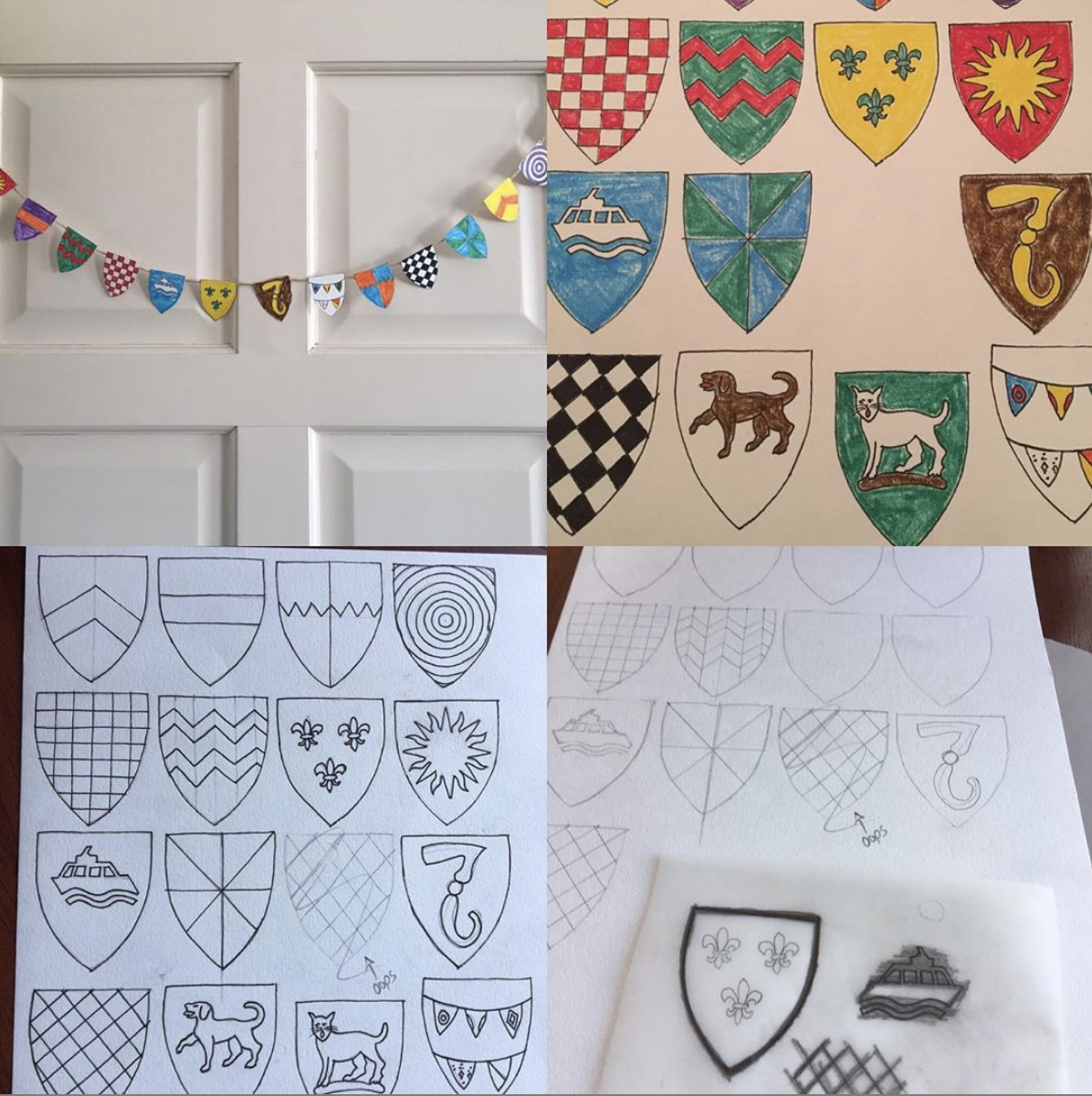
I rather like 'lozengy' and 'gyronny' and used them in my own heraldic bunting shields, most of which were taken from the book about heraldry I have and some were made up. I used tracing paper to copy a general shield design from the book and used that to create a bunch of blank shields, then I used either ruler and pencil to mark out shapes or traced them. The riverbus logo (looks a bit like a boat, though not much like a galleon) I traced off my iPhone screen which was quite fiddly.

Then I coloured them in, cut them out and taped them to a bit of string before hanging on my living room door.

If you do have a printer and want to use my design help yourself (there's a gap where I made a mistake!).


The pic above on the left is the one I drew and scanned in (photographed with phone), the one on the right is the resulting line drawing produced after running it through (free) Inkscape.

The coloured-in heraldic shields
     
I used a bit of string to hang up my bunting but you could just arrange it on a table or the floor to take a photograph.


Book of Traceable Heraldic Art
http://heraldicart.org/


Using DrawShield (no printer / no paper needed)
The DrawShield website will let you create shields using a 'blazon' (the language used to describe a shield). You can learn more about blazons and blazonry here.

One of two of my shields are not exactly valid, heraldically-speaking, but try inputting the following blazons to create some shields (then try reversing the order of colours or changing them completely).
  • Or a chevron tenné = gold / yellow with an orange chevron
  • Purpure a bar tenné = purple with a horizontal orange bar 
  • Quarterly, per fess wavy, tenné and azure = split in four, wiggly horizontal line, orange & blue 
  • Argent a gurges purpure = White / silver shield with a variant 'gurges' (whirlpool) of purple. The concentric circles shown here is less common, pinched from the family De Gorges' shield, the more common variant (same blazon) results in a spiral pattern.
  • Checky gules and argent = checkerboard pattern, red and white / silver
  • Barry dancetty vert and gules = Wiggly horizontal lines, shield is green, wiggly lines are red
  • Or, three fleurs de lis vert = gold / yellow shield with 3 fleur de lis flowers on it 
  • Gules a sun or = red shield, gold sun
  • Azure a ship argent = blue shield, white ship (in my own case it's the logo for the River Bus)
  • Gyronny of vert and azure = repeating panels of green and yellow (try 'gyronny of six vert and azure' for a variant)
  • Tenné a fleam or = Orange / brown (I think modern heraldry distinguishes these colours but Ye Olde version just treated it as one) shield with a gold / yellow fleam.
  • Lozengy sable and argent = lozenge pattern in black and silver / white
  • Argent a hound tenné passant = White / silver shield, brown dog 'striding' (facing left with right forepaw raised)
  • I did a cat (argent) one too on a green (vert) shield
  • And a non-heraldic bunting upon bunting one. The thing that looks like a pair of yellow and red pants is actually Or, two flaunches gules (Gold/yellow with red flanches / flaunches)


Previous adventures in Buntingmas
An even easier way to make bunting from folded paper - no printer needed #Buntingmas (9 April 2020)
Remember the chain of paper dolls you made as a child, cutting out a half person shape on folded paper then unfolding and producing a chain of people holding hands? Same, but with bunting.

#Buntingmas (it's 11 Apr): How to make low-tech bunting from paper (Wed 1 April 2020)
Folding paper and producing the flags which can then be taped to string, hole punched, glued, blue tacked to the wall or damped and stuck to the window (or just arranged artfully on a table). If you've use water-solube pens etc to decorate them you might want to give the 'damp and stick to window' a swerve, but I stuck a blank bunting to my window on 1 April and it's still there.

How will you celebrate Buntingmas? Craft ideas and classroom activities (Sat 28 Dec 2019)
This post lists some craft options including cake decorations (roll out some icing, cut vaguely triangular shapes, stick on a cake), bunting can be knitted or crocheted, made from modelling clay, actual fabric, paper or you might prefer to draw some online bunting.

The post also has some suggestions about using patterns on flags in communication - eg maritime signal flags, or using the position of flags as the communication (eg semaphore).  Not mentioned in the post is heraldry (another post is coming on that topic) but there's a link to an article about kids making their own coat of arms or personal flag by dividing a shield or flag shape into four and then drawing some favourite things in each segment.


Thursday, 9 April 2020

An even easier way to make bunting from folded paper - no printer needed #Buntingmas

My clever friend Yasmin sent me this simplified bunting pattern, which makes a string of small bunting flags (plus the connecting 'rope') from a piece of paper, in the manner of folding-and-cut-once to make a string of people.

Here's her drawing, click on it to enlarge. Below is the result when I tried it out (my paper is quite thick so I didn't fold it all the way across as it would have been hard to cut).

If you're celebrating #Buntingmas (it starts this Saturday and carries on throughout lockdown, or as long as you want really) then this is possibly the quickest and simplest way of generating some bunting (short of already having bunting ready - all possibly forms of bunting are valid). Some more ideas are in the blog posts linked at the end.

Instructions: fold one edge of a piece of A4 (or any) paper then continue folding in a concertina style back and forth to end up with a piece of paper that looks like lots of letter W when looked at from the side. Cut out a small perpendicular notch, then angle the scissors down to form a pointed half triangle to join the other side. Once cut and unfolded this will produce a string of triangles with a connecting piece between them - a string of bunting, ready to be decorated.

A photograph of one string of bunting made using the method above, showing the unfolded points forming a single string of bunting. Multiple strings can be made from one piece of paper - the flags are small and will probably stick to a window just with water if you don't have glue or other sticky things (or prefer not to use).

You can then trim off the top section (shown on the left in this picture) and repeat the process multiple times down your folded concertina strip.

Take a picture and share it using the tag #Buntingmas :) 

Previously in #Buntingmas
#Buntingmas (it's 11 Apr): How to make low-tech bunting from paper (Wed 1 April 2020)
Folding paper and producing the flags which can then be taped to string, hole punched, glued, blue tacked to the wall or damped and stuck to the window (or just arranged artfully on a table). If you've use water-solube pens etc to decorate them you might want to give the 'damp and stick to window' a swerve, but I stuck a blank bunting to my window on 1 April and it's still there.

How will you celebrate Buntingmas? Craft ideas and classroom activities (Sat 28 Dec 2019)
This post lists some craft options including cake decorations (roll out some icing, cut vaguely triangular shapes, stick on a cake), bunting can be knitted or crocheted, made from modelling clay, actual fabric, paper or you might prefer to draw some online bunting.

The post also has some suggestions about using patterns on flags in communication - eg maritime signal flags, or using the position of flags as the communication (eg semaphore).  Not mentioned in the post is heraldry (another post is coming on that topic) but there's a link to an article about kids making their own coat of arms or personal flag by dividing a shield or flag shape into four and then drawing some favourite things in each segment.


Wednesday, 1 April 2020

#Buntingmas (it's 11 Apr): How to make low-tech bunting from paper


Before the Great Coronavirus Pandemic of March (and beyond) 2020 I had planned to invite myself round to various chums' houses in April, or invite them to mine, to celebrate #Buntingmas with wine, cake, and bunting.

Buntingmas (11 April 2020) is a festival to celebrate bunting, which I always associate with springtime, blossoms, April, Victoria sponge cake and general pleasantness outdoors, with the sun shining (but not too much). There's probably lemonade too.

Bunting always seems a cheerful thing and we need extra cheering during the Coronavirus lockdown, so let's buntify our environs hyperlocally (garden / house / flat / quarantine room). Then take photographs of it and share it on social media, or just enjoy it quietly at home.

From my previous post in December, "How will you celebrate Buntingmas? Craft ideas and classroom activities" -
"The very simple aim of Buntingmas is to 'put up' some bunting in whatever way 'put up' is relevant for you. If you hate bunting don't do that and instead you are merely encouraged to 'put up with' bunting."
Some people will have ready-made bunting, or have sewing machines and fabric, others will have printers and can either design and print their own (I've used PowerPoint and the Insert Shape tool to fill a page with tesselated triangles - help yourself to mine) or print them from the internet.

But here is a way of making some very low-tech paper bunting.

1. How to make paper bunting

1. Find a bit of paper (or part of a cereal packet)
2. Cut triangles from it (if you have scissors)
3. Draw on them for decoration (coloured pens, pencils, crayons, glitter etc)
4. Arrange them, photograph them and share them on Twitter (or Instagram or wherever)
5. If you have string or thread and tape or blue tack you could (a) poke holes in the corners with a needle or hole punch (if you have one of those!) or (b) fold the top edge over some string or thread, trim the bit now sticking out (if you want) and then hang a chain of them up somewhere. Paper flags will, if slightly wetted, stick to windows unless you've recently cleaned them.

Here's a simple way of creating some flags from a piece of paper (I used A4 in the example below) - just fold it into triangles and then tear (or cut) along the lines.

2. Bunting from paper folded first in three, then folded into triangles

This method will make at least 18 flags from A4 paper. You can probably squeeze one or two more from the bit left over at the end but they might not be the same size.

 Right click, open in new tab / window to enlarge the image


Fold the sheet lengthwise into thirds to letterbox it, then fold one corner back onto the letterbox and then keep doing so (but in a concertina fashion, not over on top of itself as you won't get really crisp edges) to end up with lots of triangles, displayed below.

18 flags made from folded and torn paper (no scissors used).

3. Pointier bunting from paper folded in two, then folded into triangles

This method will make at least 10 flags.

Fold the sheet in half lengthwise then fold the corner back to any point on the opposite side, such that the shape of the triangle formed is pointedly bunting-like and reasonably even-looking (you are going to trim it anyway). Then do the concertina back and forth folding as above to end up with the shape at the end. Cut or tear off the bits at the open end - I drew a rough line across to guide me but corrected with my scissors.


     2. The unfolded concertina                                       3. 10 flags, possibly more from leftover paper

In picture (3) above some of the flags are positioned on top of the leftover paper to show that more flags could be cut out, making 13 in all.

4. Decorating your bunting
Block colour, stripes, polka dots, doodles, minimalist-plain - it's all good. If you're looking for some inspiration try typing doodle ideas or bunting patterns into Google or any other search engine and scrolling through the images. Or pick any theme you like and use Google's filter to show only line drawings (Tools > Type > Line drawings... or choose Clip Art).

5. Displaying your bunting
Take a photo, share it, tag it #Buntingmas. If you don't have tape, blue tack, string or drawing pins to hang it up (vertical bunting, the usual orientation) it's very acceptable to share temporarily horizontal table bunting or floor bunting.

6. Buntingmas FAQ
When is Buntingmas?
11th April 2020 but much like Christmas it can last quite a long while (as long as you like really and I recommend keeping the bunting up until we're released from quarantine). For example Christmas Day is on 25 December but shops are selling festive tat several weeks (months) in advance, and of course the decorations can stay up until 6 January (the Mondayest day of the new year, whatever day it actually falls on). I have Smallest Bunting from Flying Tiger (it's tiny!) permanently installed in my kitchen (see previous post for pictures).

Why is Buntingmas?
Just for fun.

When should I take down the bunting?
a) never b) whenever you feel like it.


Saturday, 28 December 2019

How will you celebrate Buntingmas? Craft ideas and classroom activities.

Updated links for #Buntingmas 2023 on Tuesday 11 April 2023.

Original post
Buntingmas (or The Festival of Bunting) is a thing I invented in 2019 to celebrate bunting. The first Buntingmas is on Saturday 11th April 2020. I'm still working out the details ;)

https://twitter.com/JoBrodie/status/1200522305295790082


While I'm not particularly pro-monarchy (I don't much mind them) I remember greatly enjoying the 'floribunta' that bloomed across UK high streets in 2011 when one of the royals got married. 

Tom Scott created Buntify the internets, a bunting overlay for websites that wanted to do do their civic bunting duty. It was a bit of fun that let you add bunting and a patriotic jingle to any website. There were even bunting fights in supermarkets as they ran out of the tethered celebratory flags. Then in 2012 we had all the Olympic bunting so there were a couple of years of fairly heavy bunting exposure.

https://twitter.com/my53rdchoice/status/616979930031747072


The very simple aim of Buntingmas is to 'put up' some bunting in whatever way 'put up' is relevant for you. If you hate bunting don't do that and instead you are merely encouraged to 'put up with' bunting.

I think of the 'type specimen' of bunting as a series of fabric pointed flags strung together but it's up to each individual Buntingmas celebrant to decide what sort of flags, pennants or other types of bunting to use.

1. Craft options
2. Classroom activities and other educational opportunities
3. Other posts I've written about Buntingmas

4. Gallery of my favourite bunting

1. Craft options
These might include paper/card and string bunting, knitted or crocheted bunting as well as the more classic fabric bunting creations. There's also bunting jewellery made of polymer clay, bunting 'toppers' to stick on cakes or fondant edible bunting as in the video below. Sometimes there are bunting making classes / workshops.


Or you can just buy bunting.

2. Classroom activities and other educational opportunities
While bunting has a celebratory air about it, the wider use of flags as a communication tool is pretty fun and interesting.

  • Signal flags and codes in the classroom
  • How to teach semaphore using flags
  • For younger classrooms each child could make a 'personal flag' (including stuff on it that they feel best represents them) either to decorate the room or take home. The instructions suggest getting other classmates to guess who created each flag.

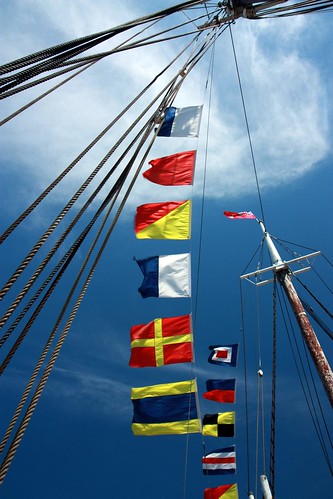
The photo of the flags on a boat below actually spell out 'Welcome Aboard', using the code of the international maritime signal flags. I have a tea-towel with the signal flags info on it (Mr Brown also wears an apron with the pattern on in Paddington 2).


3. Other posts I've written about Buntingmas

Heraldic shields to print and colour in for #Buntingmas (8 April 2022)
#Buntingmas 2022 - basically let's all put a bit of bunting up (3 April 2022)
Vaguely Celtic 'bunting' for Buntingmas made from acetate OHP sheets and glass paints (11 April 2021)
Make your own heraldic bunting for #Buntingmas (10 April 2020)
An even easier way to make bunting from folded paper - no printer needed #Buntingmas (9 April 2020)
#Buntingmas (it's 11 Apr): How to make low-tech bunting from paper (1 April 2020)


4. Gallery of my favourite bunting
All photos taken by me, most are on Twitter.


Mini-bunting above comes from Tiger in Lewisham, though it has shops all over the place. This bunting is permanently installed above my kitchen door. Tiger / Flying Tiger occasionally also sells mini bunting as well as larger garlands.


I created the above space-themed bunting using laminated paper (designed on PowerPoint, with images added). It tells the story of the film I'm screening (The Dish) at the 2018 Charlton and Woolwich Free Film Festival. The bunting is attached to one of the guy ropes holding up the open air screen set up in the grounds of Charlton House. My boss' son now owns this bunting. (I also made some work-themed bunting for my boss' office).


Imagine all this bunting whiffling in the breeze at the 2017 Wilderness Festival. Someone had festooned the Information Tent with colourful bunting making it very easy to find.


This is a lantern I made for the Dec 2018 Blackheath Village Day at the bunting making workshops held in Blackheath Halls / Conservatoire. The logo / theme of BVD is actually bunting (!) so I adopted that for the theme of my lantern, lit with a battery-operated tea-light.


Bunting in the colour of the Ukrainian flag, patterns available to download: Heraldic shields to print and colour in for #Buntingmas (8 April 2022)