Stuff that occurs to me

All of my 'how to' posts are tagged here. The most popular posts are about blocking and private accounts on Twitter, also the science communication jobs list. None of the science or medical information I might post to this blog should be taken as medical advice (I'm not medically trained).

Think of this blog as a sort of nursery for my half-baked ideas hence 'stuff that occurs to me'.

Contact: @JoBrodie Email: jo DOT brodie AT gmail DOT com

Science in London: The 2018/19 scientific society talks in London blog post

Showing posts with label alternative medicine - cancer. Show all posts

Thursday, 2 November 2017

Seller of GcMAF on trial - 'banned' product, unlikely claims made for it

Some of the people behind Immuno Biotech Ltd are to stand trial later this week for selling products containing GcMAF which has been wrongly touted (papers retracted by the journals that published them) as a cure-all for a number of conditions, including cancer. Despite that this trial does not appear to involve the Cancer Act 1939.

There's no good evidence that GcMAF is of any particular use as a treatment for anything and the fact that it's derived from blood products means particular care would be needed when giving this sort of thing to people.

In 2015 the MHRA (Medicines & Healthcare products Regulatory Agency) shut down a Cambridgeshire factory (UK's MHRA Shuts Down GcMAF Plant, 27 Feb 2015) that had been producing GcMAF (also known as First Immune).  The product itself is unlicensed / unapproved (effectively 'banned') so may not be marketed for anything and the equipment used to produce it may have been contaminated because poor manufacturing processes were in place.

It was also banned from import into Guernsey in Feb 2015 and their health department urged users or former users of GcMAF to contact their GP.

David Noakes, CEO of Immuno Biotech Ltd, is a former Guernsey resident who appeared on The One Show in 2015 talking about GcMAF - the interview did not appear to go well.


He and colleagues* appeared at Southwark Crown Court yesterday before their trial begins on 5 Nov (or possibly in 2018, conflicting reports "All four will stand trial at the same court next year.") - it's expected to take six weeks.

Further reading
*David Noakes - CEO, Brian Hall - associate, Emma Ward - biochemist and Loraine Noakes - distribution firm director and also his ex-wife.

Things to bear in mind
There are several different ways in which an untested alternative "treatment" can cause harm -
1) by containing an ingredient that's harmful, or by being prepared in such a way that means harmful ingredients are present at problematic doses
2) by being utterly harmless but containing nothing of use and offering no real help - wasting time for getting real treatment and wasting money
3) by offering false hope


Sunday, 19 October 2014

Cancer Act 1939 convictions in the UK

You are welcome (encouraged!) to repost this. If you know of other cases please tell me, thanks.

As its name suggests the Cancer Act 1939 (legislation | Wikipedia) has been around for over 70 years. Until a year or two ago I was only aware of a handful of cases that had been tried under the Act with one or two convictions and fines but, thanks to an MP's question in Parliament, I've learned that there have been 21 cases brought under the Act since 1984 (I don't know how many of them resulted in a conviction and fine though).

This year alone has seen three convictions (that I'm aware of), which is quite surprising. Two were brought to court by Westminster Trading Standards and one by Essex Trading Standards.

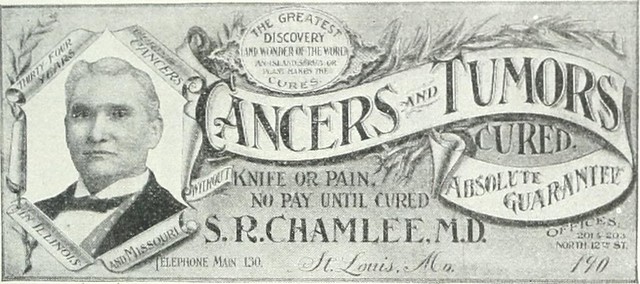
Image from page 46 of "Nostrums and quackery; articles on the nostrum evil and quackery reprinted, with additions and modifications, from The Journal of the American Medical Association" (1914)


Convictions under the Act

Westminster Trading Standards, 2014
First and second cases
Trading Standards: cancer cure claims prosecuted (23 July 2014) Westminster Trading Standards
Article discusses two cases. The fine for the first case was £9,000, court costs £9,821 plus victim surcharge of £100 (total £18,921). Following an appeal it seems that this has been reduced to £4,500. The fine for the second case was £1,750 with costs of £2,500 and a victim surcharge of £120 (total £4,370).

First case
Harley Street practitioner claimed he could cure cancer and HIV with lifestyle changes and herbs, court hears (11 December 2013) The Telegraph and Bogus doctor claimed he could cure cancer using herbs, avocado and grape seeds (10 October 2014) ITV
Refers to the £4,500 fine received by Errol Denton (sometimes trading as Fitalifestyle Ltd / SeeMyCells) on appeal, which I've assumed is a reduction in the original but could actually be additional.
TS: Westminster Trading Standards

Second case
Bodybuilder turned Harley Street nutritionist fined for claiming he could CURE cancer with diet and fitness techniques (6 May 2014) Daily Mail
Fine, for Stephen Ferguson (of The Natural Health Clinic) fined £1,750 and ordered to pay £2, 500 costs and £120 victim surcharge. 
TS: Westminster Trading Standards


Essex Trading Standards, 2014
Third case
Man is fined after selling "cancer cure" which he made at home (15 September 2014)
Steven Cook was fined £750 and costs were £1,500. The fake treatment was colloidal silver. This was the second time he had been prosecuted by Trading Standards (the first in September 2013), more at Essex Trading Standards newsletter (page 3, p4 of 23pg PDF).
TS: Essex Trading Standards

Previous cases, 2010, 2009, 2008, 2002, 2000, 1995/6, 1994
'Miracle' healer who claimed to be able to cure cancer in £30 sessions fined £2,600 (15 March 2010) Daily Mail
Fine was £600 for Adrian Pengelly, costs £2,000 with £15 victim surcharge.
TS: Hereford Trading Standards

Dursley woman pleads guilty over ‘magick’ cancer remedy (3 August 2009) Stroud News & Journal
Fine information for Donna Sims trading as Herbal High Magick not given (she was given a two-year conditional discharge so perhaps no fine) but costs were £1,100. 
TS: Gloucestershire County Council Trading Standards.

Meeting with Cabinet Member - Communities (17 August 2009) Derbyshire County Council
A report on completed prosecutions under trading standards legislation which includes, on page 3 information about a company (Healthwize UK) fined £800 for breaching Food Labelling Regulations and claiming to cure cancer. A news report [Breaston firm fined for illegal claims (9 March 2009) This is Nottingham] suggested that the total fined was higher: £2,000 fine and £2,235 costs.
TS: Derbyshire County Council

Pill salesman convicted over £500 'cancer cure' (10 September 2008) Metro 
Andrew Harris, who sold Triamazon via the internet, was "given a two-year conditional discharge and ordered to pay £350 costs at Trafford Magistrates’ Court, Manchester."
TS: assume Trafford Council Trading Standards

Firm fined for miracle tea claims (16 October 2002) This is Wiltshire
Peter Goss of Health4All fined £5,000 with £2,688.50 in costs.
TS: Swindon Trading Standards

Big fine for 'lethal' cancer machine claims (7 November 2000) CWN (news for Coventry & Warwickshire)
Reports on company directors (Leslie Goodall and Guy Stanway of Plasmafire UK) fined £14,500 with additional costs (separately and combined as the company) under several pieces of legislation including the Cancer Act 1939.
TS: Warwickshire Trading Standards.

Trading standards prosecute after "cancer relief" claims (January 1996) HealthWatch newsletter #20
Report on a case from 21st November 1995, at Camberwell Magistrates Court. Southwark Trading Standards Service brought the case against a man (Rolf Gordon Dohm, company named Dulwich Health Society) who claimed his medical device (MagneTech) could be of use to people undergoing cancer treatment. Fine was £3,500 and costs of £200.
TS: Southwark Trading Standards

British company fined for falling foul of Cancer Act (15 January 1994) BMJ 1994;308:158
Fine was £500 and costs £3,500. Welsh company (Eladon Ltd from Bangor, selling Elagen), case heard in Whitminster. (Yes it's definitely Whitminster, not Westminster or other typo, I checked).
TS: unknown


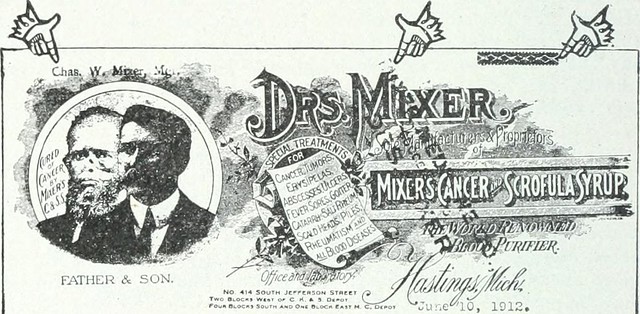
Image from page 65 of "Nostrums and quackery; articles on the nostrum evil and quackery reprinted, with additions and modifications, from The Journal of the American Medical Association" (1914)


Cancer Act 1939 as a deterrent, 2014, 2012, 2009/10
As reported in a handful of blogposts it seems that occasionally Trading Standards will contact organisations and individuals and ask them to remove problematic words or phrases from their marketing material. This suggests that 'breaching' the Cancer Act 1939 results in a series of events before any court proceedings are begun, and that people / orgs who comply with initial requests from Trading Standards will probably not be fined as the case is unlikely to be taken further.

'Cancer - there is hope' seminars reported to Trading Standards (18 November 2014) Good Thinking Society.
Dr Francisco Contreras of Mexico's 'Oasis of Hope' clinic has planned three seminars in London, Milton Keynes and Manchester, cities which are are covered by their own local Trading Standards bodies. The events are being advertised by the cancer charity 'Yes to Life' and, after discussion with Newham Trading Standards (London), they have amended the event advert for London. Trading Standards for Hackney (London), Milton Keynes and Manchester have also been involved - more at the Good Thinking Society's website.

Flyer claiming supplement could cure cancer taken down and reported (31 October 2014) Ask for Evidence website, from Sense About Science.
Sense About Science's 'Ask for Evidence" website encourages people to do just that with info on how to go about it (politely). It also shares example and in this one a flyer in a leisure centre claimed that a food supplement could cure several conditions including cancer. The person who saw it reported it to Trading Standards and the leisure centre itself (which has removed the flyer). I don't know if there will be any further follow-up though as the person also mentioned they didn't manage to contact the company (the contact details didn't work).

Trader warned for making claims herbal remedy was a treatment for cancer (30 September 2014) Hackney Gov news
Ms Adenike F Omojola has a stall at Ridley Road market which had been selling Moringa Oleifera with claims to cure / prevent several conditions, including cancer. The product's websites (Modrosel .com & .co.uk) were asked to make changes to claims too,  and Greenwich Trading Standards also alerted as one of the websites registered there.
TS: Hackney Council Trading Standards 

The Brit witch doctors charging £3,000 to 'cure' cancer (16 March 2014) Daily Mirror
Added for info, no mention of Trading Standards. This appears to be an undercover report from journalist but does not suggest any criminal proceedings undertaken or even whether the case was reported to the police. Fatt-ha Grami from Streatham and Reza Moussavi from Liverpool both mentioned as being healers claiming to be able to cure cancer, for a price.

Caught in the Act (9 July 2012) WDDTY
Recommendations from Trading Standards resulted in the name change of a book from Cancer Handbook to Cancer Book.
TS: presumably Devon Trading Standards, but other trading standards bodies appear to have got involved.

Alternative cancer conference banned by town council (15 May 2012) The Healthy Home Economist
The article's author is highly miffed that a cancer-related event was "banned" and includes mutterings about medical fascism and the possibility of a grave-spinning Winston Churchill. See also Dangerous ideas of the doctor who defends baking soda cancer cure (25 March 2012) Sunday Express about the event, organised by Dr Stephen Hopwood of the Arcturus Clinic in Totnes. Dr Tullio Simoncini was due to speak at an event to launch the new Totnes Cancer Care Clinic but his claims that baking soda could cure cancer resulted in withdrawal of permission, by Totnes Town Council, to host the event at the Civic Hall.

The Cancer Act 1939 (date not obvious to me, assume 2009 / 2010) Cancer U Can blog
Indicates that the blogger was contacted by Trading Standards with a recommendation to make some changes to the text to avoid a £1,000 fine. The blogger agreed not to refer to cancer in a six week course they were running about the therapies that apparently helped them to recover and changed its name to 'Transforming Serious Diseases'.

Note that many people who respond to cancer-related queries from Trading Standards and amend their material will not show up in internet searches - these are the equivalent of the Advertising Standards Authority's 'informally resolved' cases. Anecdotally I've heard that some companies have stopped trading / closed their website, but I don't have any details on this so can't confirm.

Cancer Act mentioned but no cancer convictions, 2011, 2005, 2004, 1961
'Shaman' Peter Aziz jailed over psychedelic drug drink (2 September 2011) BBC News
Peter Aziz jailed for 15 months over the contents of a drink which contained a class A substance. He had additionally claimed his drink could cure cancer and had previously been investigated by Devon County Council's Trading Standards in 2006 [Trading standards 'cancer cure' probe (7 January 2006) Herald Express (Torquay)].

10 Year disqualification for cancer cure director (7 March 2005) M2 newswire
David Lee (company: Blue Water Partners Ltd also trading as The British Prostate Association) sold 'Prostectalin' for cancer without evidence. He was disqualified, by the Secretary of State, from acting as manager of a limited company for 10 years from 21 February 2005.

Asda fined for mango health claim (26 October 2004) BBC News
The company was fined £5,000 under Food Labelling Regulations 1996: 40 (1) and 44 but a charge under Section 4 (1) of the Cancer Act 1939 was dropped.

British Medical Journal - Medico-legal section of the 20 May 1961 issue.
"The fourth charge, of advertisement contrary to the Cancer Act, 1939, was found not proven: offending leaflets had been printed, but there was no evidence of their publication."

Non-Cancer Act convictions
Sometimes cancer is mentioned in the reports but the prosecution or conviction wasn't done under the Cancer Act 1939.


Other possible breaches, 2012, 2011 Obviously it is up to a court to determine if someone has actually breached the Cancer Act 1939 but it is usually fairly obvious if someone is skating a bit close towards that point.

Undercover probe exposes church offering cancer cure (15 August 2012) Hold the Front Page
No Trading Standards involvement in this example (Victorious Pentecostal Assembly) but the article mentions that the claims made could well be illegal. There are a number of churches which seem to skate close to the CA1939 including those offering miraculous healing oils, miracle mineral solution (now known as master mineral solution - basically bleach). See also on this story: 'Miracle healing': Nigerian pastor lands trouble in UK (22 September 2012) Just Believe blog

Ofcom mulls smackdown for rogue religious TV channel: Ribena is not the blood of Christ and won't cure cancer (23 August 2011) The Register
"Ofcom also points out that anyone watching Believe TV is probably quite gullible, or, as the regulator puts it: "the self selecting audience of Believe TV ... may have been less likely to question the potentially harmful and exploitative content broadcast"." - no mention at all of Trading Standards involvement however.

Cancer Act-ivism
Shark cartilage in the water: effective legislation is already in place but is not being properly used (9 December 2006) BMJ
"I have now made successful use of this legislation in relation to patients who have used cancer therapies that have been advertised in both the complementary health sector and by registered medical practitioners associated with a registered pharmacy."

Further reading
New treatments for cancer need careful study. There is no evidence that a vegan diet cures patients (14 December 2014) Sunday Business

Comments on this post
I am no longer adding further examples of these almost-identical generic comments despite receiving between three and five a day of them as I think their purpose (which is to help people be aware that they're spam comments in case they come across them elsewhere) is served already. Anyone trying to leave a comment of that nature here, with promises of miracle cures and whatnot, has been pre-cursed by me and will experience dreadful pains before a lingering death. It's only what you deserve ;) Mwahahaha.


Friday, 11 April 2014

I'm seeing a lot of people asking this: "Do you know about the Cancer Act of 1939?"

This question seems to have cropped up rather a lot in recent weeks*. If you type "cancer act" 1939 into Twitter you'll see a stream of tweets about it - most of them seem to be pointing to only one or two forum posts, and they all seem to say the same thing. There seem to be a few convergent conspiracy theories about it.

I'm intrigued as to why there's a sudden (apparent) interest in the Act.

Briefly, it's an Act of Parliament that makes it an offence to offer to treat someone for cancer or give advice about treatment...

"4 Prohibition of certain advertisements.

(1)No person shall take any part in the publication of any advertisement—

(a) containing an offer to treat any person for cancer, or to prescribe any remedy therefor, or to give any advice in connection with the treatment thereof;"
...unless you are making the information available for healthcare practitioners.


There haven't been very many prosecutions under the Act, though things probably don't get that far as most people will remove misleading claims after discussions with Trading Standards. A few websites have closed down, events have tried to move venues (doesn't really work, still illegal) or speakers have been removed from the programme - it all seems to be quite low level stuff really.

Incidentally I've known of the Act since at least 2010, it's fairly well-known among skeptic bloggers I think.

*to be fair I've not really been looking for it before now so I don't know if it's always been this much talked about, or if this is a real and recent increase.

Additional comments policy - note that any approved comments are very likely to be published as plain text with no website hyperlinks. This is both an anti-spam and anti-conspiracy-theory strategy.


Sunday, 23 March 2014

Despite strong regulatory action live blood analysis is still with us

The news on Thursday that a practitioner of live blood analysis had been fined £19,000 for making misleading claims about cancer is part of a series of events where live blood analysts have been under increasing regulatory scrutiny in the UK and abroad. Earlier this year US-based live blood analyst Robert O Young was arrested and charged with 18 counts of practising medicine without a license, and theft.

In July last year, after three years of adjudicating on complaints about live blood analysis, the UK's Advertising Standards Authority and Committee of Advertising Practice wrote overarching guidelines for what live blood analysts are allowed to claim in their marketing material. 'Not much' would be an accurate description as they can only say that they offer the test.

Live blood analysis is a fake diagnostic tool that sounds and looks sciencey (microscopes, microscope slides, camera, computer screen, discussion about blood and health, possibly someone wearing a white coat while doing so). Apart from the costs of the 'test' it exists to sell a mixture of perfectly sensible dietary advice along with unnecessary and expensive supplements. In at least one case someone has been given alarmist (and wrong) health information about cancer.

It's a waste of money and thanks to Westminster Trading Standards bringing this latest Cancer Act of 1939 case to completion at Westminster Magistrates Court I imagine it might be easier for victims to get their money back if they've spent anything on this nonsense.


Further reading (and listening)

1. The recent regulatory action 
£20,000 bill for cancer claims man Jersey Evening Post (21 March 2014)
• Conclusion of the case brought by Westminster Trading Standards, at Westminster Magistrates Court.

Harley Street practitioner claimed he could cure cancer and HIV with lifestyle changes and herbs, court hears The Telegraph (11 December 2013)
• An earlier hearing of the case above which, not being concluded in time, resulted in the later March hearing.

'Cancer cure' alternative health practitioner appears in court Trading Standards Institute news (~December 2013)
• "Westminster Trading Standards has instigated legal proceedings against an alternative health practitioner who uses a room in London’s Harley Street, for making various claims contrary to the Cancer Act 1939. "

Therapies: Live Blood Analysis Committee of Advertising Practice (~July 2013)
• "CAP is yet to see any evidence for the efficacy of this therapy which, without rigorous evidence to support it, should be advertised on an availability-only platform."

2. Audio clips on some of the ASA's adjudications
Blood tests BBC You and Yours (11 March 2013)
• The ASA upholds more complaints against a man offering ‘live’ blood tests.

Live Blood Tests BBC You and Yours (15 March 2012)
• "Why adverts for a test which lets you see your own 'live' blood cells on a computer screen have been criticised for failing to prove claims they have the potential to prevent illness or disease."

3. The ASA adjudications against claims made about live blood testing
• ASA (24 April 2013) ASA adjudication on Live Blood Test
• ASA (27 February 2013) ASA adjudication on Live Blood Test
• ASA (6 March 2013) ASA adjudication on Steps to Perfect Health
• ASA (16 January 2013) ASA adjudication on the Natural Health Clinic 
• ASA (2 November 2011) ASA adjudication on Fitalifestyle Ltd: Fitalifestyle Ltd
• ASA (19 October 2011) ASA adjudication on Optimum Health UK
• ASA (7 September 2011) ASA adjudication on MyCityDeal Ltd: MyCityDeal Ltd t/a GrouponUK
• ASA (1 June 2011) ASA adjudication on Fitalifestyle Ltd t/a seemycells.co.uk
• ASA (13 October 2010) ASA adjudication on Live Blood Test

4. ASA Non-compliant online advertisers offering live blood analysis
• ASA (12 March 2013) Live Blood Test
• ASA (15 February 2013) The Natural Health Clinic - this person has since removed their misleading website claims and so has now been removed from the non-compliant list
• ASA (26 June 2012) London Natural Therapies 
• ASA (15 November 2011) Fitalifestyle (claims about blood-cleaning properties of chlorophyll)

5. Background reading on live blood analysis as a bogus test
• Edzard Ernst (2005) A new era of scientific discovery? The Guardian
• Mark Crislip (2009) Live Blood Analysis: The modern auguries Science Based Medicine blog 
• Wikipedia's article on Live blood analysis
• Thomas Patterson (2012) The Pseudoscience of Live Blood Cell Analysis Skeptical Inquirer
• Zachary Rubin (2009) Live Blood Analysis: New Diagnostic Method or Quackery? Case report and Review of the Literature UCLA Department of Medicine
• Posts tagged with Live Blood Analysis on Josephine Jones' blog 


Saturday, 9 February 2013

#Burzynski - is this normal clinical trial practice?

The year before last I wrote a blog post expressing surprise at how many trials the Burzynski Clinic had running and after recent events (rumours that the Burzynski clinic is under unprecedented scrutiny from the FDA, but note this caveat tweeted by @medtek) I wondered what had changed.

Back in November 2011 I found 61 trials, this year by searching for the name Burzynski it seems there are now 62 (however the last one, this trial, actually relates to a completely different Burzynski so no change in numbers at all, h/t @dianthusmed).

It also appears that there have been more trials but not all of them registered, according to a paragraph on a page from 1998 on Quackwatch's website, highlighted to me by @jonmendel
"Working outside peer review, Burzynski is conducting 71 concurrent, preliminary phase II trials that cover most cancer indications-an unheard of number for a single investigator, and for a drug which is yet to be proven effective for any indication."

What struck me was that the ones I looked at on the first page (of 'unknown' status) all follow the same format of "Antineoplaston therapy in treating X (patients) with Y (type of cancer)" and all on the first page (shown below) are followed by this line (indicating the type of treatment given) appears below all of them: Interventions:     Drug: antineoplaston A10;   Drug: antineoplaston AS2-1

From the first page of results (brown = status unknown for more than two years, red = withdrawn, purple = terminated, green = completed - though is it published and what happened?):
  • Antineoplaston Therapy in Treating Patients With Stage IV Adrenal Gland Cancer
  • Antineoplaston Therapy in Treating Patients With Residual or Recurrent Anaplastic Astrocytoma
  • Antineoplaston Therapy in Treating Patients With Brain Tumors
  • Antineoplaston Therapy in Treating Children With Brain Tumors
  • Antineoplaston Therapy in Treating Children With Low-Grade Astrocytoma
  • Antineoplaston Therapy in Treating Patients With Anaplastic Astrocytoma 
  • Antineoplaston Therapy in Treating Patients With Recurrent or Refractory Mixed Gliomas
  • Antineoplaston Therapy in Treating Patients With Primary Malignant Brain Tumors
  • Antineoplaston Therapy in Treating Children With Primary Malignant Brain Tumors
  • Antineoplaston Therapy in Treating Children With Visual Pathway Glioma
  • Antineoplaston Therapy in Treating Patients With Refractory or Recurrent Intermediate-Grade Stage II, Stage III, or Stage IV Non-Hodgkin's Lymphoma
  • Antineoplaston Therapy in Treating Patients With Recurrent or Refractory High-Grade Stage II, Stage III, or Stage IV Non-Hodgkin's Lymphoma
  • Antineoplaston Therapy in Treating Patients With Mantle Cell Lymphoma
  • Antineoplaston Therapy in Treating Patients With Primary Central Nervous System Lymphoma
  • Antineoplaston Therapy in Treating Patients With Advanced Mesothelioma
  • Antineoplaston Therapy in Treating Patients With Stage IV Melanoma
  • Antineoplaston Therapy in Treating Patients With Multiple Myeloma
  • Antineoplaston Therapy in Treating Patients With Recurrent or Refractory Waldenstrom's Macroglobulinemia
  • Antineoplaston Therapy in Treating Patients With Metastatic, Recurrent, or Refractory Neuroblastoma
  • Antineoplaston Therapy in Treating Patients With Neuroendocrine Tumor That Is Metastatic or Unlikely to Respond to Surgery or Radiation Therapy
Are all these trials running at the same time? The way the titles are written it seems as if the antineoplastons A10 and AS2-1 are being trialled in children and adults with a fairly broad range of cancer types (or stages of a particular cancer type).

Searching for antineoplaston A10 brings up 61 hits and searching for antineoplaston AS2-1 brings up 60, so possibly there's at least one Burznyski trial listed in the 62 that has nothing to do with antineoplastons (could be someone with the same name of course).

Is that usual where the type or stage of cancer has a very poor prognosis and no-one has the luxury of time to wait and see how these ANPs perform in one situation before trying them in the next?

For comparison I had a look at GLP-1 and spotted a few that had similar titles, but there seemed to be much more variance in title, and trial status. One is even listed as having results...

Feb 2012 - Searching just for the antineoplaston A10 trials, we get 61 of which:
  • 0 are recruiting
  • 50 are of unknown status
  • 7 are withdrawn
  • 2 are terminated
  • 1 is completed
  • 0 are active, not recruiting
  • 1 is not yet recruiting
Note that Unknown status incorporates some of the other categories
UNKNOWN (RECRUITMENT STATUS)
A clinical study in ClinicalTrials.gov with a status of Recruiting; Not yet recruiting; or Active, not recruiting and whose status has not been confirmed within the past 2 years. Studies with an Unknown recruitment status are considered open studies or closed studies, depending on their last recorded recruitment status.

Nov 2011 - Here's what I found in November 2011 (but I think I searched on Burzynski rather than antineoplaston A10 so there's a caveat there)
  • 10 are recruiting
  • 35 are of unknown status
  • 7 are withdrawn
  • 2 are terminated
  • 1 is completed - it began in March 1996 and was completed in 2005. Its clinical identifier is NCT00003509 and this does not appear anywhere in PubMed.
  • 5 are active, not recruiting
  • 1 is not yet recruiting

While writing this post @majikthyse also published a post on the Burzynski Clinic which makes very interesting reading.

Comments relating to conspiracy theories or personal attacks on anyone will be ignored.

Friday, 2 December 2011

Burzynski Clinic tweets #burzynski

Thursday, 24 November 2011

The Burzynski clinic has ever so many trials

I'm not sure what to make of the Burzynski Clinic. Twitter is currently filling up with the disturbing news that one of their PR people has sent the blogger @lecanardnoir a threatening lawyerly type letter (which you can read, along with his response, on his blog).

This coincides with the fact that there is a benefit gig happening tonight with some big names - the purpose is to raise money to send a little girl with cancer to the Burzynski Clinic in the US for a treatment for which, as far as anyone can tell, there isn't enough evidence that any benefits outweigh the risks. There are some testimonials but those don't count unfortunately.

It's surprising that there's not much evidence because there are so many trials ongoing, 61 according to one of the clinical trials register - ClinicalTrials.gov. This is a basic search for any record that includes the word Burzynski anywhere within it so I should be cautious before drawing any major conclusions because a trial might be nothing to do with them but just reference them...

As far as I'm aware a trial registration isn't an indication of quality or whether or not the trial is a fair test of a treatment, merely that it's been registered.
Of these 61 trials:
10 are recruiting
35 are of unknown status
7 are withdrawn
2 are terminated
1 is completed - it began in March 1996 and was completed in 2005. Its clinical identifier is NCT00003509 and this does not appear anywhere in PubMed.
5 are active, not recruiting
1 is not yet recruiting
There are plenty of trials published by Burzynski about antineoplastons (the name of the intervention) although they don't seem to match up with the clinical trials registration (I've not looked at all of them so it's certainly possible that some of them do).
It seems there was a big trial but that it fell apart amidst big fights...