I'd really enjoy an Angine de Poitrine-based Music HackSpace-adjacent event which is aimed at a general public audience that touches on a variety of things such as
the electronic engineering involved in creating
effects pedals and things that let you create and replay loops.
Something like the creative tech festivals such as Maker Faire / EMF / Wuthering Bytes
etc) with talks on all the above plus stalls where you can try things
out, playing with ring modulators, looper demos and also stuff like circuit-bending.
Polka dot face-painting for the kiddies, hotdogs for lunch and merch
tables selling t-shirts but also water bottles with long straws
attached ('la paille!!').
Musicologist Prof Milton Mermikides is giving a series of
free in-person and YouTube live-streamed talks for a general public
audience about music, through Gresham College (London). These are really
interesting and entertaining. Scroll to the bottom of this page to see future events as well as past videos to watch (e.g. "The Maths of Music (and the Music of Maths)" with Milton and Prof Sarah Hart).
Also 'How Music Works' and 'The Story of Music' by Howard Goodall are excellent UK television series and available to watch on YouTube.
Following on from my Imaginary Maritime Science Festival (full of good ideas even if I say so myself) I have begun thinking about the science in Paddington 2 and what my imaginary science festival based on it might look like. Pretty good actually. Give my (slightly stretched) links between the film and science listed below a hard stare and see what you think.
Andean spectacled bears
Oranges...
...and marmalade
Botanical art
3D representations: Origami
3D representations: rendering of images in computers
Robotics
Facial recognition technology
Steam trains
1. Andean spectacled bears Paddington's look is based on a real bear, Tremarctos ornatus (spectacled bear) - they're rather cute. I think there could be a lecture about their lifestyle and habitat, conservation efforts and so on, and relationship with other types of bear.
2. Oranges... In 2007 I spent a happy fortnight at the University of Leiden studying on their Economic Botany course (ethnobotany with a particular focus on how humans use plants). Much like dogs plants are bred for all sorts of reasons and when it comes to fruits it's things like flavour and peelability. The citrus family is full of created fruits with a long lineage from ancestral forms of deliciousness. While studying there I managed to get to eat a few of the more unusual ones (it was a wonderful and fascinating course, led by David Mabberley).
3. ..and marmalade Plenty of science in marmalade making - role of pectin, extractions and filtering, flavour molecules, sterilisation of glass bottles etc. Perhaps there could be a workshop in which everyone gets to go through the process of making marmalade and then takes home a jar of marmalade. Depending on how long the process takes that bit may involve pre-made marmalade.
4. Botanical art This would possibly fall in the Arts & Crafts section of the festival (which, by the way, is interdisciplinary) as this obviously involves drawing - but it has been an important tool in scientific understanding and discovery and was incredibly important before photography got underway. Herbaria are library collections of dried plants (herbarium specimens) and are beautiful, if sometimes a little eerie.
5. 3D representations: Origami There's a lovely bit in the film when Paddington imagines his aunt Lucy seeing a pop up book of London (first video) and I think we might have a nice session on the science of folding and space-saving. For example the second video shows a foldable solar array for use on space satellites (I think there's similar stuff going on with antennae too, which can be folded for launch and unfurl once in orbit).
6. 3D representations: rendering of images in computers The wonderful Framestore once came to QMUL's computer science department to give a talk about their work on the film Gravity. Normally these talks are tolerably well-attended, this one was packed with people turning up all the time trying to squeeze in. It was also the same day as the Christmas Party so normally people would have been happy to bring things to a rapid conclusion and get to the beers and wine but we all cheerfully kept the Framestore chaps for an hour and a half pelting them with questions about how they'd done all this amazing stuff in computers. They also did the fantastic Visual Effects (VFX) for Paddington 2 and you can see some of their work in the video below.
7. Robotics A bit more tenuous but there will be people who could talk you through what it would take to 'animate' one of the bins at Paddington station and have it wheel around the concourse thanking anyone who drops something in it.
8. Facial recognition technology Phoenix Buchanan spends most of the film trying to disguise himself as different characters so that he can get close to various London landmarks without suspicion to collect a variety of letter clues deposited on them (these are to be played as musical notes on a fairground organ which will unlock it, letting the player access the treasure within). At 1m 33s in the video below Mrs Brown is having tea with Phoenix Buchanan and, alerted by his comment about a pencil drawing having blue eyes, realises that he is the thief as all the images of him drawn for the wanted posters suddenly overlay over his eyes. It reminds me of a scene in the film Amelie in which she makes a discovery (don't watch the video if you've not seen the film as it will spoil things for you).
There could be an interesting talk about facial recognition technology, how it's been used and misused - how biases in algorithms can hurt some sections of society in particular - and how some (though not all) police forces have stopped using it.
9. Steam trains Slightly more tenuous but the Brown's son Jonathan is particularly keen on them and learns about them in his holiday, putting this knowledge to good use at the end of the film. Lots to be said about steam power, from a historic point of view too, and here are some fabulous photos of exploded boilers. Yikes.
"It is a bright sunny evening: the sea reflects a thousand glowing colours, and, in a minute or two, I shall be gliding on its surface." Dreams, Waking Thoughts, and Incidents by William Beckford
My thoughts are never very far from boats at the best of times and this only increases when I'm waiting for the ferry home to Greenwich, North Greenwich or Woolwich (I like to vary things a bit). While I was waiting for the Thames Clipper ferry home I jotted down, on my phone's 'notes' app, a bit of a brainstorm for an Imaginary Maritime Science Festival. Bagsy Festival Director, obviously.
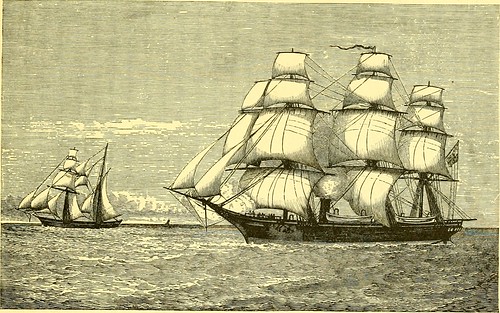
Over Easter (April 2017) Greenwich and Woolwich (not sure about North Greenwich) will be hosting the Tall Ships festival 2017, the last one (in fact the first in Greenwich / Woolwich) was in September 2014 so I'm assuming these tend to happen about every two years or so in future. Tall ships are quite large vessels with masts and sails and they look gorgeous and afford many photography opportunities. Some are static, some waft gently on the water. People can even board them. Most of them are, as far as I'm aware, entirely modern ships rather than re-enactments but they look totally re-enactment-y. I think some of them will sail up and down the Thames with visitors on them.
On land there are also other entertainments, last time there was woodworking and all sorts of stalls. Plenty of bunting. But I wondered about the science. Just up the hill from the water's edge there's Greenwich Park which contains its very own National Maritime Museum and Royal Observatory Greenwich. They'll be open over the festival and they have lots of cool stuff to see and do as well: http://www.rmg.co.uk/search/site/tall%20ships
Here are some of the talks, film screenings and other events that we'll have at my #IMSF (Imaginary Maritime Science Festival unless someone else is using that hashtag in which case it might be #IMSF2019). I might have got a bit carried away, but fortunately the Assistant Festival Director will be there to rein me in ;) Maths and knots
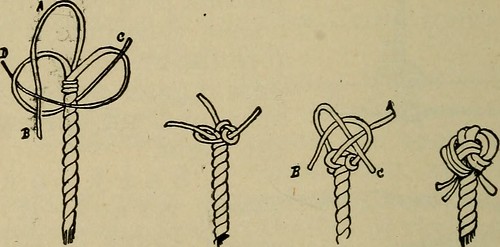
I went to a great interactive talk ('The Mathematics of Knots') at the Orkney Science Festival in 2015 which featured mathematician Dr Julia Collins from Edinburgh University and knots expert Mark Shiner of Stromness Nautical School. We got to play around with bits of string and tie some knots too, it was ace.
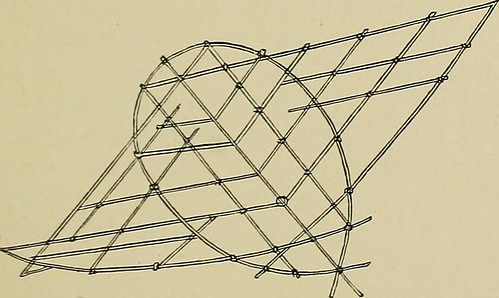
Linked activities: flexagons (Martin Gardner's maths puzzles, hexahexaflexagons also used by colleagues to teach computational thinking concepts and graphs / maps (mathematics))
Communication
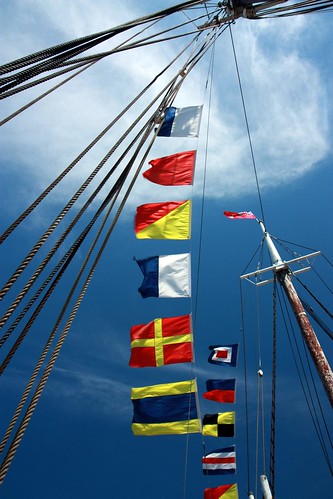
Flags and semaphore, Morse and telegraphy (laying cables also pretty cool). I want to run a signal flags workshop, using string, paper and coloured pencils and get people to make a string of flags with a word or phrase or their name. While I'd probably not bring a laptop or tablet to such an event (too portable / pinchable) you can find out very quickly what flags form your name here.
Edit 28 May 2017 - I've just worked out that these flags spell out "Welcome Aboard" with the flags for 'aboard' nearest to the viewer and part of the 'welcome' message cut off. You can check this for yourself on Wikipedia's page on the meaning of the International Maritime Signal flags.
. The flags have very different meanings when not displayed in this format, for example the L flag (third one down on the further-away bunting, it's a yellow and black check) means either "The ship is quarantined" when in harbour, or "You should stop your vessel instantly" when seen out at sea.
The one below is from 1902 and uses some of what are now number pennants for the letters.
Film screenings
Obviously Longitude which is about Harrison and his clocks, possibly Titanic / Poseidon Adventure might be pushing it a bit.
Medicine and diSEAse (see what I did there) A talk from the James Lind Alliance on his C18th randomised controlled trial for scurvy which suggested that citrus fruits were a good idea. Someone might also talk about A Day in the Life of a Ship's Surgeon which I'm expecting to contain a fair bit of amputation-related gore (or in which I learn that it was mostly splinters from wood). Perhaps a bit more gruesome might be talks on recovery from drowning, and 'mammalian diving reflex' - I'd certainly encourage everyone to read 'Drowning doesn't look like drowning'.
Life on board ship
Practising staying upright I imagine, among other things. This lends itself to multiple comparisons - different types of ships and modern versus ships of yore.
Boatbuilding
Ye Olde Ships involved a fair bit of wood, and the right type of wood at that. What makes some wood better than others. You probably won't be surprised that I went to a lovely lecture on different types of wood, as part of an economic botany course a few years ago. Modern ships seem fairly metallic. I don't know if a great deal of metalwork has ever been done ON ships, but I suppose other than the ship itself the largest lump of metal is probably the engine or the anchor.
There was a lovely Ray Mears programme from a few years back in which he and a friend created, from scratch, a birch-bark boat - made from the peelable bark of the birch tree. In the UK we can peel birch tree bark too but it's paper-thin and doesn't lend itself much to boat building.
Navigation
Astronomy - when I went on a 2 week cruise a couple of years ago I entertained myself beforehand by looking into getting one of those sextant deelies and a big book of what to do with one. It turned out to be a bit more involved and fiddly so I didn't follow it up but I'd love to learn how you point something at a star, look up something in a book and declare that it's 9.32pm on Tuesday the Umpteenth of Month 1739 or something like that. Polynesian navigation seems extremely interesting too, I'd like to hear how different cultures found their way around and home again.
Definitely want talks on longitude, possibly accompanying the film screening, also accuracy. Plus GPS and satellites, and how you can keep an eye on ships around the world with things like Shipfinder. Tides are also probably fairly important! And the Moon.
Power and movement
Buoyancy - a notable thing about ships is that they float, when all's going well, and go forward at impressive speeds. Engines are pretty interesting, propellors, steam, those wheel things. Sails (shape, catching the wind - which leads me to wind power more generally, and wave power).
Desalination / recycling
On-ship water can be re-used.
Military
Talks from the Royal Navy / RAF on how they land aeroplanes and helicopters on aircraft carriers and take off again. That's a bit clever.
Trade routes
Other than probably not being at war with Spain over Gibraltar people use ships to explore and trade, not to mention un-fun things for whales (whaling for oil!). In Greenwich we have the lovely tea clipper called the Cutty Sark which zipped around the world collecting tea and probably other stuff too. There's a fantastic film called City of Ships from 1940 which looks at the produce coming in to Tilbury Docks near London - that would definitely be in the film screening strand.
Piracy
Even if only for the opportunities for dressing up and saying 'Aarrgh' a lot. Maggi Koerth-Baker's article on actors taking on the role of pirates for a museum exhibition is absolutely brilliant. The actors did so much research. A great read: Real history from a pretend pirate. My favourite pirate, Stede Bonnet, wasn't very good at it. At the Tall Ships festival this year someone will be dressing up as Pirate Jack Sparrow from the Pirates of the Caribbean franchise. No sign of Cutler Beckett, alas.
Great Sea Voyages
Darwin... Cook... people who did the Grand Tour by boat.
Social and cultural
In addition to a 'day in the life of' there's also sea shanties, carving scrimshaw and other crafts, experiences of people left behind, plenty of sea related poetry, other traditions. Maritime mythology... mermaids and whatnot.
See also
This post was written several years before mine but I just discovered it yesterday (30 April 2020) but clearly we're kindred spirits :) It's aimed at school groups who are going to attend the Penobscot Marine Museum with suggestions of activities to do before they come: Life at Sea: activities
If you look at the panel on the right you'll see links to more activities for different age-ranges.
Edit: 22 October 2022 - I've updated the videos as most of the links had stopped working!
- - - - - - - - - - - - - - - -
When I came across the Belbury Parish magazine [now resolves to Ghost Box records - "a group of artists exploring the misremembered musical history of a parallel world"] I had a bit of an 'aha' moment and understood better all the slightly odd cultural reference points I'd grown up with. It was all a bit weird in the 70s and 80s though I'd probably not really noticed it at the time.
"There's nothing wrong with men in their forties enjoying shared tastes and nostalgic triggers, but do they have to be so po-faced about it?" The Quietus
If I was running an imaginary film festival / celebration of television programmes at the BFI here are some of the things I might put in it. Of course there'd be anti-deep-vein-thrombosis breaks every couple of hours otherwise I'd just sit watching the entire thing for a day, lost in a dwam.
I've put small versions of the YouTube videos below but just click to enlarge / watch them at YouTube.
The Clangers (1972)
Narrated by Oliver Postgate (who also narrated the marvellous 'The Alchemists of Sound', a 2003 about the history of the Radiophonic Workshop) with music by Vernon Elliott.
The Clangers - The Music of the Spheres.
The original videois no longer available but showed Tiny Clanger helping to get a flying machine to actually fly
by using notes from the musical tree proving that you just need the
right music to get going. See also: Ivor the Engine
Dr Who (1974-ish)
Beyond the wonderful Tom Baker and co I remember very little about the actual storylines, it's really just the music - written by Ron Grainer and arranged by Delia Derbyshire, and tweaked by various people throughout the series' life that grabbed me.
Mark Ayres explanation, in the The Alchemists of Sound, of how it was put together with tape loops is one of my favourite bits of recorded television. It's at 15m 40s (see below).
See also: Blake's Seven
Children of the Stones (1976)
"...widely regarded as the scariest children's television serial ever made. It's chilling theme music, eerie atmosphere sending a generation of terrified youngsters scurrying behind the sofa" - so says the continuity announcer for Stewart Lee's Radio 4 programme about the serial. I never saw it - I found it by accident while I was looking for another kids programme (not found it yet, bunch of children, something to do with an amulet, but it's not Children of the Stones).
I watched this last Christmas in full, loved it.
Sherlock Holmes (1984) The Devil's Foot (1988)
Jeremy Brett and Edward Hardwicke head off to Cornwall and while there investigate some mysterious deaths. It involves a rather good bit in which Holmes experiences a sort of botanical acid trip with some colourful cinematography and some strange music, at about 36 minutes in.
If there ever was a Sherlock prom I think I'd secretly quite like it if they included the theme tune from this series as well (edit: they did!).
Robin of Sherwood (1984)
I watched this religiously (along with Sherlock Holmes) every week when it was on, usually round at the house of family friends. We loved Michael Praed and the pagan references. And the music of course.
Box of Delights (1984)
I actually have no recollection of this at all - I discovered it last year after reading a blog talking about strange programmes from my childhood. Not sure how I can have missed it but it's a little bit magical and has a great theme tune.
The Moondial (1988)
I was 18 when this was broadcast so probably getting a bit old for this sort of thing but I loved the opening theme music and secretly wished I was called Araminta ;)
Alchemists of Sound (2003)
The only programme I've seen since the 1980s that really captures some of my childhood, thanks to the music of the BBC Radiophonic Workshop. I saw it when first broadcast and stayed up until 3 in the morning to watch the repeat. Fortunately it's now available on Daily Motion (note there are audio ads in it).
Berberian Sound Studio (2012)
Peter Strickland's evocative film about sound effects / Foley. It's wonderful and spooky, set in a 1970s Italian studio while making a film about witchcraft with a lot of women screaming, the on-screen violence is never shown, only through sound effects - it's also very funny. Soundtrack is by Broadcast, the Quietus quote above comes from the article (they like the soundtrack, just complaining about the term 'hauntology'). Toby Jones plays an English sound engineer who goes to the studio to help them with their sound effects, he doesn't have a very lovely time there.
Really? No, Really? podcast with Jason Alexander and Peter Tilden
Really? No, Really is good fun, its launch was timed beautifully for me finishing my Seinfeld binge :) Click pic above for their YouTube channel or links below for audio only, or any podcast app will do.
Really? no, Really? with Jason Alexander & Peter Tilden






 Posts
Posts

